Ace Combat 8: Wings of Theve Guide: Early Planes and Superweapons
Ace Combat 8: Wings of Theve is out now on PC, PS5 and Xbox. Here's how to build loadouts, spend early MRP and survive its superweapon fights.
Ace Combat 8: Wings of Theve launched on PC, PlayStation 5 and Xbox Series X|S on October 2, 2026, and it changes enough of the series' aircraft economy and superweapon fights that even returning pilots will want a refresher before their first few sorties. You start with a single multirole fighter, a thin wallet of in-game currency, and a carrier full of people counting on you to turn that into a working air wing. Here's how to spend both wisely, and what to expect when the campaign throws its first superweapon at you.
01What You're Flying Into
Wings of Theve's campaign puts you in the cockpit of a pilot defending the Federation of Central Usea (FCU) against the Republic of Sotoa, flying out of the aging carrier Endurance alongside three new squadmates. According to Bandai Namco's official game overview, operations launch from Endurance and every sortie opens with a mission briefing covering your objective and strategy before you commit a loadout. Endurance itself is part of the story's framing: it's an older ship, crowded with people the FCU couldn't get to safety elsewhere, which is what makes the propaganda value of a legendary ace pilot so useful to command.
The "Wings of Theve" title is a plot point rather than just packaging. Early reporting on the reveal described the callsign as a morale-boosting legend built around the player character, not a reputation earned the normal way — expect the campaign's opening missions to play with that gap between the story command tells and what you're actually capable of in the cockpit.
Mission types vary between dogfighting, air support for ground troops, and air-to-sea sorties, so the aircraft and weapons that carried you through one briefing can be the wrong tool for the next. Read every briefing twice before you touch the hangar — the objective line usually tells you whether you're chasing fighters, grinding through ground armor, or hunting ships, and that should decide your special weapon before anything else does.
02Build Your Loadout Before Every Sortie
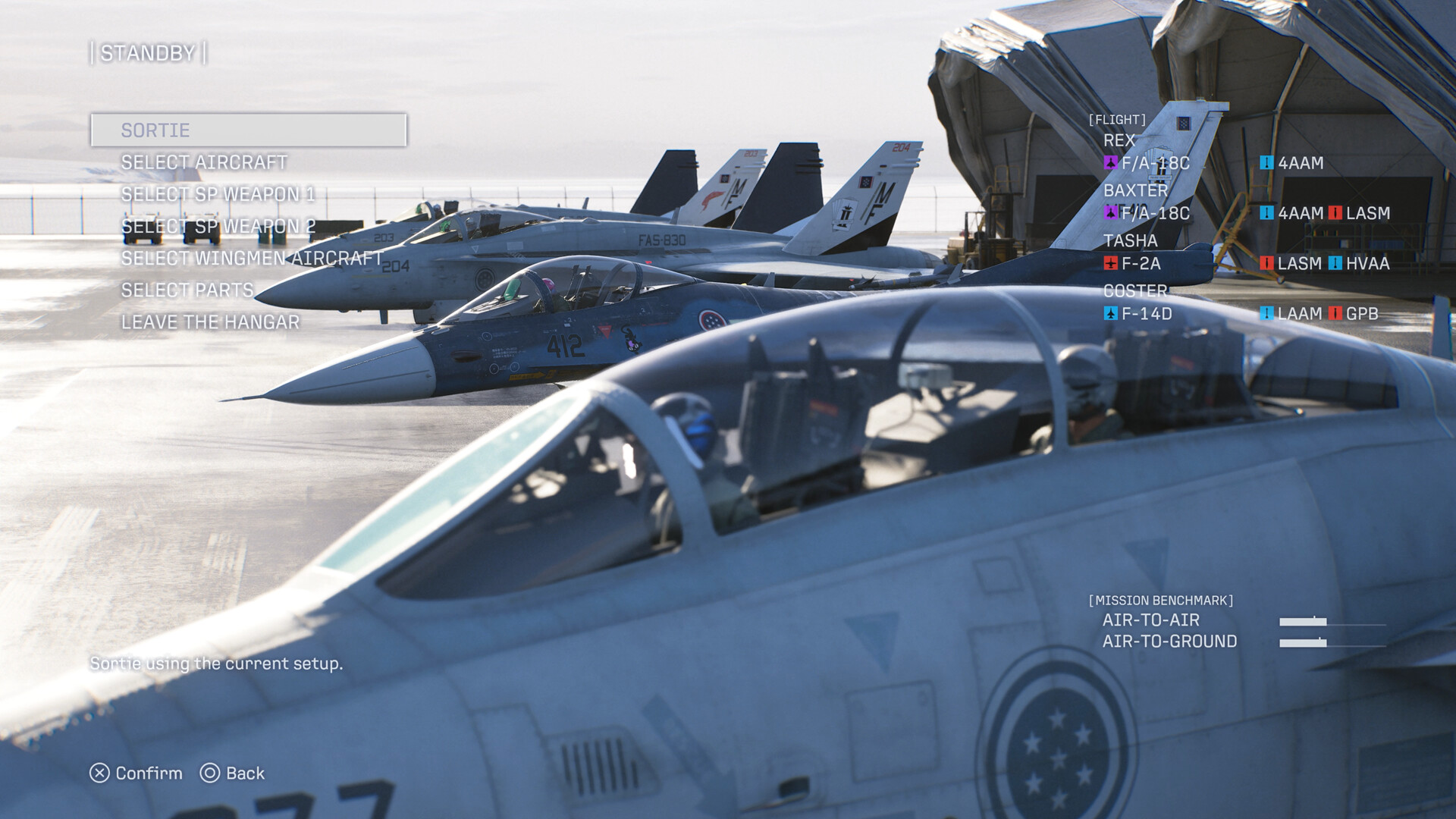
The hangar is where Wings of Theve actually plays out between missions. Bandai Namco's own description of the system is blunt about its importance: "Optimizing your craft for each mission will make the difference between success and failure." You pick an airframe, then attach upgrade parts and a special weapon loadout tuned to that sortie's objective, rather than locking into one build for the whole campaign the way some older entries encouraged.
New aircraft and gear are unlocked with MRP, an in-game currency you earn by flying missions and spend on the game's Aircraft Tree. Early on, that MRP is scarce enough that you can't just buy a second fighter and ignore the first one — the parts and upgrades attached to your starting aircraft stay useful even after you've moved past it as your primary ride, so nothing you spend MRP on early is wasted, even if the airframe itself eventually gets benched.
The series has traditionally let you fly real-world jets alongside original, fictional airframes, and Wings of Theve keeps that mix. Your pre-order bonus, if you have one, adds the F-14A to that roster immediately (more on that below), which is a reasonable second aircraft to lean on while you figure out which upgrade paths you actually want to commit MRP toward.
03Early MRP Priorities
With a limited MRP pool in the opening hours, the practical priority is upgrading the aircraft you already have before chasing a new one. Payload and handling upgrades on your starting multirole fighter carry directly into whatever special weapons a mission calls for, and they stay attached to that airframe if you keep flying it in a support role later. Only once those upgrades plateau does it make sense to put MRP toward an additional airframe suited to a specific mission type — an interceptor for a dogfight-heavy briefing, or a strike-focused build for an air-to-ground sortie.
Exact unlock costs weren't part of Bandai Namco's own launch materials, so treat any specific MRP numbers you see elsewhere as unconfirmed until you check them against the in-game Aircraft Tree yourself — third-party cost breakdowns circulating online don't always agree with each other. What is confirmed directly from Bandai Namco is the shape of the economy: mission-based MRP, spent on an aircraft roster built around a wide selection of real-world and original aircraft, unlocked progressively rather than available all at once.
A useful rule of thumb while your MRP is still thin: don't unlock an airframe you can't yet afford to upgrade. A stock jet with no payload or mobility work behind it will struggle against the same enemies your upgraded starting fighter was already handling comfortably, so a second airframe is only an upgrade once you can actually kit it out.
Your First Few Sorties
- 1Check whether the sortie is air-to-air, air-to-ground or air-to-sea before you touch the hangar — it decides your special weapon.2 min
- 2Pick the airframe and special weapon that match the briefing, not whatever carried you through the last mission.3 min
- 3Complete the mission to earn MRP toward the Aircraft Tree; avoid risky detours early since failures cost more time than they save.10-20 min
- 4Spend MRP on your current aircraft's handling and payload upgrades before buying a new airframe.2 min
- 5Destroy the smaller aircraft and turrets around a superweapon before committing to its main target boxes.varies
- 6Order wingmen to attack a specific target or cover you rather than leaving them on autopilot during tough fights.ongoing
- 7Grab your pre-order bonus aircraft early and give it basic upgrades so it's ready as a backup airframe.2 min
- 8Jump into the eight-pilot co-op superweapon mode once your loadout can keep up with a full squad's pace.varies
04Surviving Superweapon Fights
Several of the campaign's key missions, and the entire Emergency Sortie mode below, revolve around superweapons — oversized enemy craft with multiple targeting boxes that all need to come down, carrying both strong offensive firepower and layered defenses of their own. Wings of Theve changes how punishing these fights are compared to earlier entries in the series: damage now counts even when it lands outside a superweapon's designated target zones, so a shot that would have whiffed against an older Ace Combat superweapon still chips away at the target here. Destroying an enemy aircraft or a target box near a superweapon can also trigger a chain reaction, as the wreckage collides with nearby components and does extra damage on its own.
That chain-reaction system rewards a specific order of operations: clear the smaller escort aircraft and defensive turrets ringing a superweapon first, both because they'll otherwise keep interrupting your run at the main target and because their wreckage can soften the bigger target boxes for you. Only commit to the superweapon's primary hull or core once its surrounding defenses are thinned out.
You're not doing this solo, either. Squadmates take real-time tactical orders — you can send them to attack a specific target or have them cover you while you line up a harder shot — and using those commands deliberately during a superweapon encounter, rather than leaving your wingmen on autopilot, is one of the clearest ways to turn a losing fight around. Assign a squadmate to keep pressure on a secondary target box while you focus the one that's giving you the clearest shot.
05Emergency Sortie: Ace Combat 8's Co-op Mode
Once you're past the campaign's opening missions, Wings of Theve's headline multiplayer offering is Emergency Sortie, described by Bandai Namco as "a large scale assault in which you and seven other pilots take on massive, superweapon-class threats together." It's built around the same target-box-and-chain-reaction system from the campaign, scaled up to an eight-pilot squad rather than you and two or three AI wingmen.
Bring upgraded special weapons rather than your default loadout — a full eight-person squad can burn through a superweapon's outer defenses fast, and you want enough payload capacity to keep contributing once the fight moves to harder-to-reach components rather than running dry while human teammates are still working through the target. Coordinating target priority with seven other pilots is harder to manage through voice chat alone than it is with AI wingmen taking orders, so agree on a rough plan — who clears escorts, who focuses target boxes, who's on standby for the chain-reaction window — before the mission starts rather than improvising mid-fight.
06Pre-Order Bonuses and Where to Start
If you pre-ordered, you already have two head starts worth using immediately: a playable port of Ace Combat Zero: The Belkan War from 2006, and an unlock for the F-14A. The F-14A unlock is particularly worth grabbing early, since a free airframe is a free airframe while your MRP is still tight — fold it into your roster even if you don't fly it as your primary jet yet, and spend a little early MRP on basic handling upgrades for it so it's not dead weight if a mission calls for a second aircraft.
Ace Combat Zero is a separate, self-contained campaign and not required reading for Wings of Theve's story, but it's a reasonable way to spend time between real-world patch updates if you want more of the series while your MRP bank refills, and it gives you a second data point for how the franchise's aircraft handling has evolved since 2006.
Beyond pre-order extras, the fastest way to get comfortable with Wings of Theve is simple: fly the briefed mission type you're given rather than the loadout you're used to, spend MRP on your current aircraft's upgrades before a new airframe, clear a superweapon's escorts and defenses before committing to its main target boxes, and treat every encounter as a target-priority puzzle rather than a straight dogfight. The systems above are all designed to reward exactly that kind of patience, and they only get more demanding as the campaign moves past its opening sorties.
FAQ
What is MRP in Ace Combat 8: Wings of Theve?
MRP is the in-game currency you earn by completing missions. It's spent on the Aircraft Tree to unlock new airframes, parts and upgrades.
What aircraft do I start with?
You begin the campaign with a single multirole fighter and expand your roster from there using MRP. Pre-order owners also get an F-14A unlock immediately.
How are superweapon fights different in this game?
Damage now counts even outside a superweapon's designated target boxes, and destroying nearby targets can trigger chain reactions that add extra damage on their own.
What is Emergency Sortie?
It's Wings of Theve's co-op mode, pitting a squad of eight pilots against massive superweapon-class enemies using the same target-box and chain-reaction mechanics as the campaign.
Do I need to play Ace Combat Zero: The Belkan War first?
No. The included 2026 port of the 2006 game is a separate, self-contained campaign and isn't required to understand Wings of Theve's story.
Official resources
- Ace Combat 8: Wings of Theve Game Overview (Bandai Namco)bandainamcoent.com
- Walkthrough Trailer Breakdown (Bandai Namco)bandainamcoent.com
- Ace Combat 8: Wings of Theve on Steamstore.steampowered.com
- Ace Combat 8: Wings of Theve on PlayStationplaystation.com
- ESRB Rating: Ace Combat 8: Wings of Theveesrb.org

Jonas runs the guides desk at Tutorial.Games. He replays every route, build and boss strategy on the current patch before it goes up, and re-checks it when the developer ships a balance update. Soulslikes, co-op action games and anything with a build planner.