
Terrible Lizards Beginner Guide: How to Survive the Chase
Terrible Lizards throws you into Dalton's Dinos with no weapons. Here's how to master its parkour controls and survive every creature chase.
01What Dalton's Dinos Is Hiding
Terrible Lizards opens with the kind of setup that never ends well: your car dies on Route 66, miles from anywhere, right outside an abandoned dinosaur-themed attraction called Dalton's Dinos. It's 1992, so there's no cell phone to call for a tow and no rideshare on the way. The staff are gone, but a voice on a payphone inside the park begs you to help find a missing child. You go in to find a signal, or a working phone, or anyone at all — and you quickly learn you are not alone.
Developer WDR Studios LLC built the game as a first-person horror title with no combat options whatsoever. You cannot fight back against the creatures that hunt you through the park's corridors, gift shops and animatronic exhibits; the game's own store description puts it plainly, there are "no weapons except your wits." Every encounter is a movement puzzle instead of a fight: read the space, find the route that gets you out of sight, and keep going. This guide covers the controls, the chase logic and the early decisions that make the difference between a clean escape and a dead end, without spoiling what's buried beneath the attraction.

It's also worth setting expectations before you start: Terrible Lizards is a single-player game, there's no co-op partner to watch your back, and there's no difficulty slider to fall back on if a chase goes badly. The attraction is fixed, which means the same landmarks and exhibit layouts you learn on your first run will still be there the next time you pass through, so nothing you learn below is wasted even if an early chase ends badly.
02Learn Your Parkour Toolkit First
Terrible Lizards leans entirely on momentum. Your character can run, jump, climb, wall run, bounce off set pieces and slide under obstacles, and almost every escape route in the park is built around chaining two or three of those moves together. Before you run into real trouble, spend the first few quiet minutes testing each move in empty rooms: get a feel for how long a wall run actually holds, how far a jump carries from a sprint versus a standing start, and which ledges you can climb versus ones that are just set dressing with no collision to grab onto.
This matters because the game never pauses to let you practice once a creature has spotted you. The official gameplay trailer shows the exact same vocabulary of moves used in short, improvised bursts — a climb onto a counter, a slide under a half-closed shutter, a wall run around a corner — rather than one long sprint in a straight line. Treat the opening stretch of the attraction as your tutorial even though the game doesn't label it as one, and pay attention to which moves feel natural to chain together, since you'll be making those calls on instinct later.
03How the Chase Actually Works
Because there's no weapon and no stealth takedown, every chase in Terrible Lizards comes down to breaking the creature's read on you faster than it can close the distance. The attraction's corridors, shelving and ride structures exist specifically so you can turn a straight chase into a series of blind corners. Running in open sightlines plays to the creature's advantage; cutting through tight gaps, climbing to a level it can't easily follow, or doubling back through a space you've already cleared does not.
The steps below cover the first chase sequence most new players run into, based on the movement options WDR Studios has confirmed for the game. Exact creature behavior can vary run to run, so treat this as a framework rather than a fixed script — the underlying idea of breaking line of sight and using verticality applies to every encounter in the attraction, not just the first one.
How to Survive Your First Chase at Dalton's Dinos
- 1Pause at the entrance to any new space and look for a second way out, not just the way you came in. A doorway, a vent, a climbable shelf or a wall-run surface all count. Knowing your exit before you need it is the single biggest advantage you can give yourself.~10 sec
- 2Don't sprint in the direction you were already facing. Cut toward the nearest corner, doorway or piece of cover that puts something solid between you and the creature, even if it means a shorter, less direct route.~5 sec
- 3Climb onto counters, shelving or ride structures the creature can't easily follow. Wall runs and ledge climbs cost it more time to navigate around than they cost you to execute, which is usually enough to break the chase outright.~10 sec
- 4If you've just escaped through a tight gap or climbed to safety, resist the urge to immediately return to the open corridor you started in. Give the chase time to fully end before crossing exposed ground again.~15 sec
- 5Once the creature loses track of you, take a moment before moving on. Rushing straight into the next room on adrenaline is how a cleared chase turns into a second one.~10 sec
- 6When you're ready to move again, head back toward a path or landmark you recognize rather than pushing into a completely new area. Familiar ground means you already know where the escape options are.~20 sec
04Reading the Attraction for Escape Routes
Dalton's Dinos is built as a string of themed exhibit rooms — gift shops, animatronic enclosures and maintenance corridors — rather than one open map, and that structure is your best tool. Landmark set pieces like the park's glowing exhibit stages are easy to spot from a distance and make good mental waypoints: if you know which direction the gift shop or a specific exhibit sits relative to you, you can commit to a direction under pressure instead of guessing which way leads back to open ground.
Shadows and light cues do a lot of the game's early warning for you. A creature's shadow stretching across a wall ahead, or a flicker in a light fixture down a corridor, is usually your signal to change course before it's in the same room. Because there's no minimap or objective marker pointing you toward danger, it pays to actually look up and around rather than just forward as you move through each space. Spend a beat scanning a new room before you commit to crossing it, especially the first time you enter it.
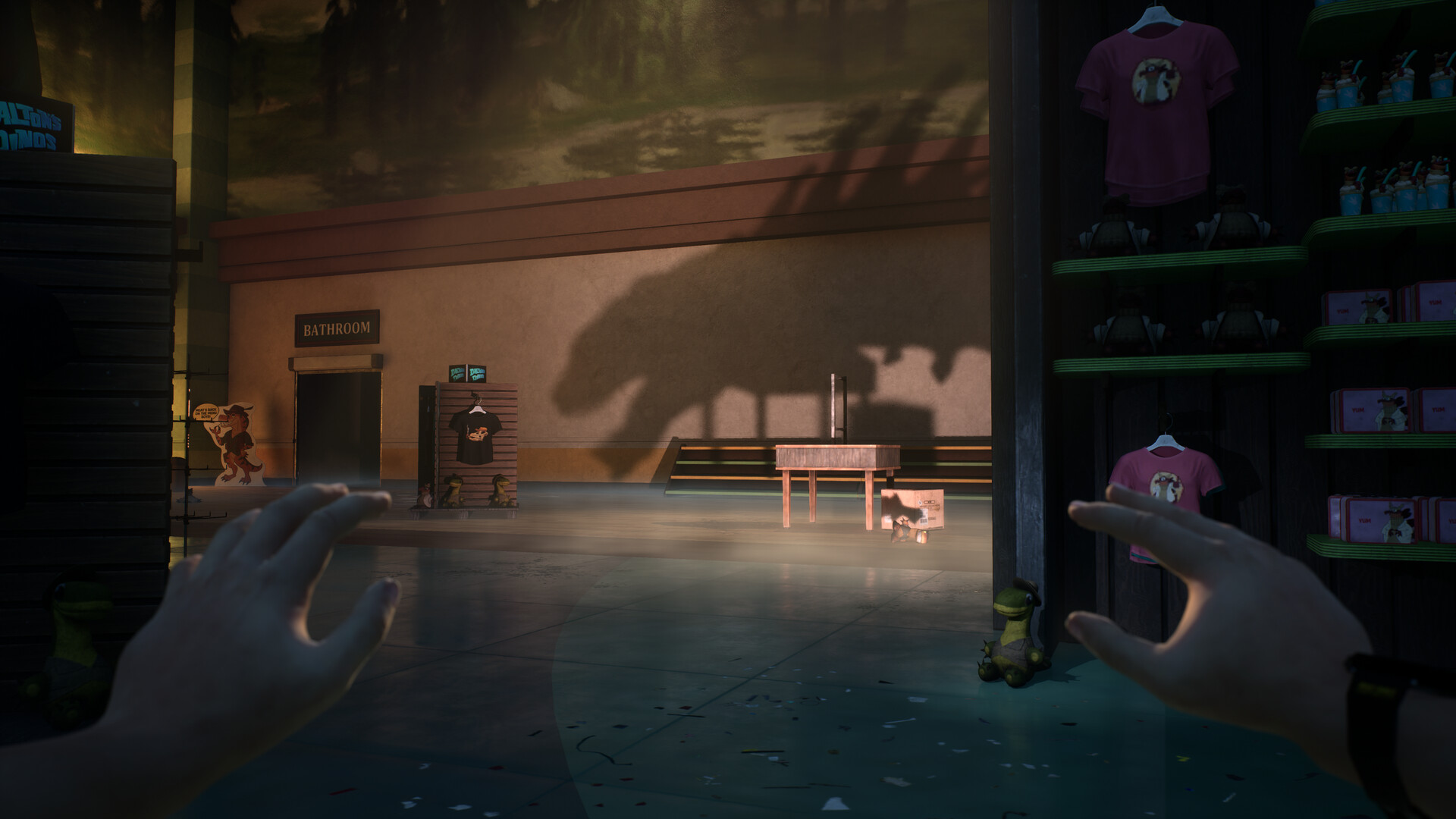
It's also worth noting which rooms are dead ends the moment you spot them. The gift shop's back corners and the narrower maintenance passages tend to funnel you into a single exit, which is fine if you're exploring at a walk but dangerous if you duck in there mid-chase without already knowing the way back out. Scouting a room while nothing is hunting you is cheap; discovering it's a dead end while something is right behind you is not.
05Collecting Tapes, Notes and Recordings Safely
The missing-child mystery and the backstory of Dalton's Dinos are told almost entirely through collectible tapes, handwritten notes and recordings scattered around the park, rather than through cutscenes. None of this is required to escape the attraction, but it's the only way the story comes together, so it's worth detouring for when it's safe to do so.
The simplest rule: only break off to grab a collectible when you have a clear, short route back to an escape path, not while you're already being chased. A tape sitting in the open near a main corridor is a safe pickup; one tucked in a dead-end room is worth skipping on a first run unless you've already scouted an exit from it. Since Terrible Lizards doesn't let you fight your way out of a bad read, a collectible is never worth getting cornered for, no matter how much story context it might fill in.
06Common Early Mistakes to Avoid
A few habits account for most early deaths in horror-chase games like this one, and Terrible Lizards is no exception. The first is sprinting in a dead straight line the moment a creature appears — it plays directly into the thing the creature is best at, which is closing a straight-line gap. Turning, even slightly, forces it to adjust its approach and buys you the half-second you need to reach a corner or a climbable ledge.
The second is panicking into an unfamiliar room instead of a known one. If you've already scouted a loop between two rooms earlier in your run, use it; a route you've never seen before is a gamble you don't need to take when a safer, slower option exists. The third is forgetting that the game gives you no combat fallback: there is no moment where fighting back is the correct call, so any plan that involves standing your ground is the wrong plan by design.
07Trailer, Platforms and What You Need to Run It
Terrible Lizards launches today, October 29, on PC via Steam, Xbox Series X|S and PS5, published by Digital Pajamas and Behaviour Interactive. It's a single-player game with no multiplayer or co-op component, and it carries an ESRB Teen rating for violence and blood. On Xbox and PC it's available on Game Pass from day one, so it's worth checking your subscription before buying outright.
On PC, Steam lists minimum requirements of Windows 10, an Intel Core i5-6400 or AMD Ryzen 3 1200, 6GB of RAM, and a GTX 1050 or RX 560 with 2GB of VRAM, plus 25GB of free storage. The recommended spec jumps to Windows 11, a Core i3-10100F or Ryzen 3 3100, 12GB of RAM and an RTX 2080 or RX 6800 XT. If you're unsure whether your rig can handle the horror, WDR Studios also published a free demo on Steam covering an early slice of the attraction, which is a good way to test both your hardware and your stomach before buying.
The official gameplay trailer above is the clearest look yet at how the parkour and chase systems work together in practice, and it's worth a rewatch once you've played the opening stretch yourself — the moves that look impressive in the trailer are the same ones you'll be leaning on under pressure for the rest of your time at Dalton's Dinos.
FAQ
Does Terrible Lizards have any combat?
No. WDR Studios built the game with no weapons and no fighting option at all — every encounter with the attraction's creatures has to be solved by running, climbing and breaking line of sight.
Is Terrible Lizards single-player or multiplayer?
It's single-player only. Steam's own store listing categorizes it as a single-player game with no co-op or multiplayer modes.
What are the PC requirements?
Minimum is Windows 10, an Intel Core i5-6400 or AMD Ryzen 3 1200, 6GB RAM and a GTX 1050 / RX 560 with 2GB VRAM. Recommended is Windows 11, a Core i3-10100F or Ryzen 3 3100, 12GB RAM and an RTX 2080 / RX 6800 XT, plus 25GB of free storage either way.
Is Terrible Lizards on Xbox Game Pass?
Yes, Microsoft's own Xbox store listing confirms it's available on PC Game Pass and Game Pass Ultimate from its October 29 launch day.
Is there a demo before I buy?
Yes. WDR Studios published a free Terrible Lizards demo on Steam covering an early part of the attraction, which is worth trying before committing to the full game.
Official resources

Jonas runs the guides desk at Tutorial.Games. He replays every route, build and boss strategy on the current patch before it goes up, and re-checks it when the developer ships a balance update. Soulslikes, co-op action games and anything with a build planner.

